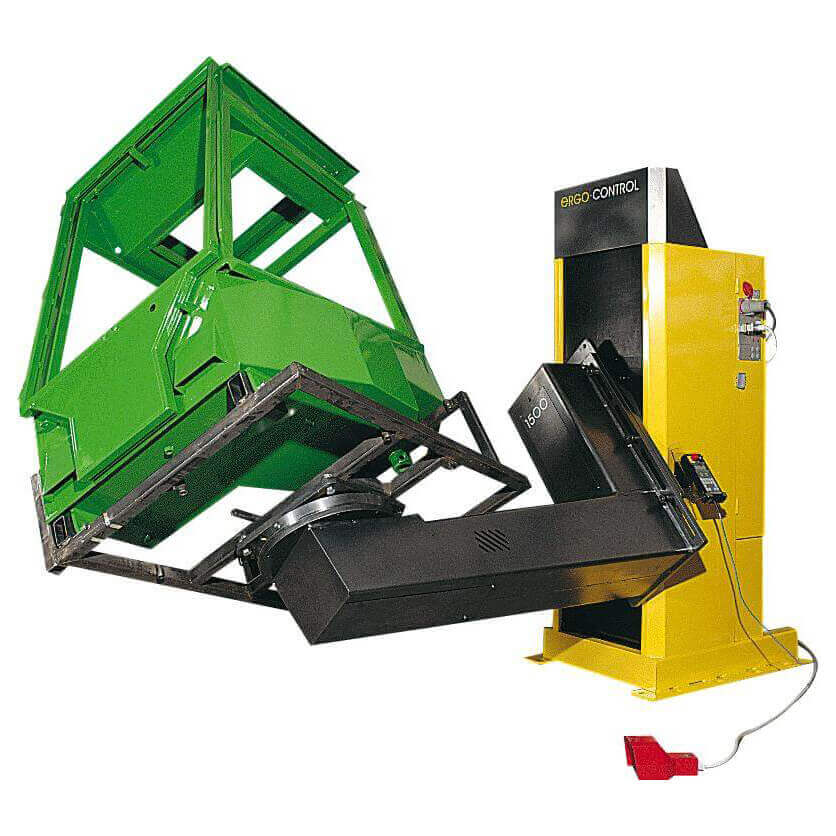
Heavy-Duty Weld Rotators: Positioning Workpieces Up to 17,600 Pounds

Key Takeaways
- A turning-roll weld rotator is for cylindrical parts that spin on their own diameter. A heavy-duty positioner holds, turns, and tilts parts that cannot roll, which is what most heavy fabrication actually needs.
- The signal to move up in capacity is not just weight. It is the crane entering the welding sequence, multi-person repositioning, and welds made out of position because turning the part is too hard.
- Above a few thousand pounds, controlled speed, stability through the tilt path, a dedicated ground path, and stored positions matter more than headline capacity.
- A built-in 400A rotary ground removes cable wrap and gives welding current a designed return path instead of an improvised one.
- Teach programming converts a skilled setup into a repeatable one, which is where the shift-to-shift consistency comes from.
- Powered positioning reduces crane cycles to one load and one unload, which removes most of the rigging exposure from the job.
- Size the system on weight, center of gravity, required tilt, and fixturing together. Geometry drives the spec as much as tonnage does.
There is a point in every fabrication shop where the equipment stops being the right tool for the job. A welder starts calling for the crane between passes. Two operators hold a chain while a third pries the part around. The setup takes longer than the weld. Nobody logs it as a problem, but it is costing hours a week and putting people next to a suspended load several times a day.
That is the threshold where heavy-duty weld rotators and high-capacity positioners stop being a capital wish and become an operational requirement. This guide covers what separates heavy-duty positioning equipment from a standard shop positioner, which specifications actually matter above a few thousand pounds, and how to size a system for workpieces running up to 17,600 pounds.
Weld rotator or heavy-duty positioner: what you are actually shopping for
The two terms get used interchangeably, and the distinction matters when you are writing a spec.
A turning-roll style weld rotator supports a cylindrical workpiece on driven wheels and spins it on its own diameter. It is the right answer for pipe, tanks, and pressure vessels, where the part rolls on itself and the torch stays put.
A heavy-duty work positioner holds the part on a faceplate or table and rotates and tilts it under power. It is the right answer for anything that has to be held, turned to a specific angle, and presented to the welder: machine frames, chassis, weldments, housings, and structural assemblies.
Most shops searching for a heavy-duty weld rotator have the second problem. The part is not round, it cannot roll, and it needs to sit at a defined angle while somebody works on it. Ergotronix builds that second category, engineered to order for the specific part it will carry.
When a standard positioner runs out of capacity
The published limit is the obvious signal. The operational signals show up earlier.
Ergotronix positioners cover a wide capacity range, and each line has a defined ceiling. The Ergo Master is a manual unit rated to 300 pounds. The motorized Ergo Chief carries up to 400 pounds. The Ergo Force handles 600 and 1,500 pound loads with an L-shaped arm that gives unlimited turn and tilt, including turning a part upside down. Above that, you are into programmable heavy-duty territory.
Loading a positioner past its rating is not a matter of degree. The rating accounts for the moment the load puts on the gearbox and the base, and an overloaded unit can fail without warning under a part worth more than the machine holding it. Three risks come with it: the part can tip as its center of gravity swings through the tilt path, a high-value weldment can be damaged beyond repair, and anyone near the machine is exposed to a crush hazard.
The more useful test is repeatability, not weight. You have passed the threshold when any of these is true on a regular basis:
- The crane is part of the welding sequence, not just the load and unload
- Repositioning between welds needs more than one person
- Operators pry, wedge, or lever the part to get the angle they want
- The same part ends up in a slightly different position every time it is turned
- Welds are being made out of position because turning the part is too much trouble
That last one is the expensive one. When repositioning is hard, welders compensate by welding vertical or overhead instead, and quality follows the path of least resistance.
What defines heavy-duty positioning equipment
Above a few thousand pounds, maximum capacity is the least interesting number on the datasheet. These are the specifications that decide whether the system works on your floor.
Torque and controlled speed under load. Turning several tons smoothly matters more than turning it quickly. Variable speed lets the operator match rotation to travel speed on a circumferential weld, which is what produces a consistent bead rather than a fast one.
Stability through the full tilt path. A load’s center of gravity moves as the part tilts, and the base has to handle that moment, not just the static weight. This is why capacity and part geometry get reviewed together.
A dedicated welding ground path. Current returning through bearings and gear teeth is a maintenance problem waiting to happen, and an inconsistent ground produces an unstable arc. A built-in rotary ground gives the current a designed path and removes the cable that would otherwise wrap as the part turns.
Stored, repeatable positions. On repeat production, the ability to recall a position sequence is what turns a skilled setup into a standard one.
Here is how the Ergotronix lines compare on the specifications that matter for welding:
| Line | Control | Published load capacity | Weld rotary ground |
|---|---|---|---|
| Ergo Master | Manual | 50, 150, 300 lb | Optional |
| Ergo Chief | Motorized, variable speed | 400 lb | Optional |
| Ergo Force | Motorized, variable speed | 600 and 1,500 lb | Optional |
| Ergo Control | Programmable, variable speed | 660 to 17,600 lb | Built-in 400A |
The Ergo Control is the line built for this weight class. It covers 660 to 17,600 pounds in two and three-axis configurations, uses an L-shaped arm with unlimited turn and tilt so the part can be positioned at any angle including upside down, and includes a built-in 400A rotary ground system for welding. The full range of work positioner solutions shows how the lines step up through the capacity range.
Why the built-in rotary ground matters more than it sounds
On a positioner without an integrated ground, the return path is improvised. A ground clamp on the part means a cable that has to be reset every time the part turns, or one that wraps and drags. A ground taken through the machine’s bearings and gears puts welding current through components that were never designed to carry it.
A built-in 400A rotary ground gives the current a continuous designed path through the rotation, so the operator is not resetting a clamp between passes and the arc is not fighting an inconsistent connection. On high-deposition work over long runs, that consistency is the difference between a bead you trust and one you grind out.
Programmable control on parts you build more than once
Manually jogging a multi-ton part into position works, and it works differently every time depending on who is running the pendant.
Teach programming changes that. An operator walks the positioner through the ideal sequence of positions once, the controller stores it, and every part after that recalls the same sequence. On a weldment with a dozen welds across four faces, the setup stops being a skill and becomes a button press. The Ergo Control’s program storage is built for exactly this, holding sequences for multiple parts or operator preferences.
Three things come out of it: less variation between shifts, less time between welds, and welds made in position because getting there is no longer a chore. Our breakdown of how teach programming cuts setup time on automatic welding positioners covers the workflow in detail, including what the programming actually looks like on the floor.
For long workpieces, two positioners can be run in a headstock and tailstock configuration, with one following the other in synchronism so a beam, shaft, or long weldment is supported and turned at both ends.
The safety case: contained rotation instead of a suspended load
The traditional method for turning a multi-ton fabrication is a crane, slings, and people. Every turn means rigging, a lift, a swing, and a set-down, with operators near a suspended load and a cleared floor area each time. Repeat that three times per part, several parts per day, and the exposure adds up.
A powered positioner changes the sequence. The crane loads the part once and unloads it once. Everything in between happens through controlled powered rotation with the part mechanically fixed to the machine. That removes the repeated rigging cycles, keeps the crane available for other work, and takes the manual pushing, prying, and levering out of the job.
The equipment still has to be guarded. OSHA’s general machine guarding requirement, 29 CFR 1910.212, calls for protection against points of operation, ingoing nip points, and rotating parts, and a large powered positioner creates all three. Fixed guarding at the drive and pinch points, accessible emergency stops, and a defined operating envelope belong in the installation plan.
The ergonomic case runs alongside the safety case. Positioning equipment exists so the work comes to the welder at a workable height and angle instead of the welder contorting to reach the work. That is the same reason so many welders report shoulder and back pain in shops where parts are welded wherever they happen to sit.
The productivity math
Run the arithmetic on a representative job. The figures below illustrate the structure of the calculation rather than reporting a specific customer result.
Take a 10,000-pound gearbox housing that needs welding on four sides. Without powered positioning, each turn means calling the crane, rigging with two or three operators, clearing the area, turning the part, and re-securing it. Thirty minutes per turn is realistic, and three turns puts 90 minutes of non-welding time into every unit.
With a programmable positioner, each reposition after the initial setup is a recall and a button press, measured in under a minute. The same three turns cost a few minutes instead of an hour and a half.
The rest of the return comes from quality and utilization: more welds made in the flat position where gravity helps, fewer defects and less grinding, and a crane freed for other work instead of being tied to one bay. If you have to present it internally, our framework for ergonomic lift equipment ROI lays out both the investment and the return side of the calculation. Good ergonomics equals good economics, and heavy fabrication is where that shows up fastest.
How to size a system for your workpiece
Weight is the starting point, not the answer. Send four things to an applications engineer and the specification comes together quickly.
- Maximum weight of the part in its heaviest configuration, including any fixture that stays on during welding
- Overall dimensions and the location of the center of gravity, since an offset or overhung load puts a much larger moment on the machine than a centered one of the same weight
- The work that has to be reached, which determines how far the part needs to tilt and whether it has to go past vertical
- Mounting and fixturing, meaning how the part will attach to the table or faceplate and whether a custom fixture is required
That last point is where engineered-to-order matters. A non-cylindrical part needs a fixture designed around its geometry, and getting that right is what makes the difference between a positioner that gets used and one that sits idle because loading it is a hassle. Ergotronix builds this equipment in the USA and engineers to the part, which also means spare parts and service come from a domestic supply chain rather than an overseas lead time.
If your work involves boom-mounted torch positioning rather than turning the part, that is a different class of equipment. Our overview of weld manipulators covers where those fit, and our guide to the rotary positioner covers continuous-rotation applications. In aerospace manufacturing, positioning equipment is often specified for access and repeatability on high-value assemblies rather than for weight alone.
Put the specification in front of an engineer
Every heavy positioning job comes down to the same four inputs: weight, center of gravity, the angles the welder needs, and how the part mounts. Get those on paper and the equipment decision is straightforward.
Send us the part drawing and the operation, and our engineers will tell you what it takes to hold and turn it safely. Schedule a consultation to review your application.