Aerospace Manufacturing Ergonomics: Lessons from Boeing and Sikorsky Programs

Key Takeaways
- The massive scale and high value of aerospace components make traditional ergonomic advice and equipment, like cranes, inefficient and unsafe for precision work.
- The most effective approach, used by industry leaders, is to “bring the work to the worker” using technology, rather than forcing workers into awkward and unsafe positions.
- This technology provides 360° rotation, tilt, and height adjustment, allowing a single technician to safely manipulate massive components with precision.
- The business case is built on measurable gains in productivity (slashing repositioning time), quality (fewer defects), and labor optimization (reducing team size for tasks).
- Choosing the correct positioner involves assessing load capacity and matching the control system (manual, motorized, or programmable) to your specific application’s needs.
In aerospace manufacturing, the stakes are astronomical. When your team is working on a multi-million dollar fuselage, a complex engine assembly, or a critical landing gear system, there is no room for error. A single dropped component can lead to catastrophic financial loss and production delays. Yet, one of the most significant and costly risks in the industry isn’t a technical failure, it’s a human one, rooted in the physical strain placed on your most valuable asset: your skilled technicians.
This is the ergonomic nightmare of large-scale assembly. The challenge goes far beyond standard safety advice; it involves positioning components the size of a school bus with the precision of a watchmaker. Industry leaders like Boeing and Sikorsky recognized that solving this high-stakes problem required a fundamental shift in thinking. They moved beyond simply asking workers to lift safely and started re-engineering the work itself.
This article explores the manufacturing ergonomics lessons learned from these aerospace giants. We’ll break down why traditional methods fall short, how multi-axis work positioners provide a definitive solution, and how this technology delivers a powerful return on investment far beyond safety metrics.
Why Traditional Manufacturing Ergonomics Fails in Aerospace
Standard ergonomic advice often revolves around manageable loads and repetitive tasks. But in aerospace, the scale is entirely different. We’re not talking about lifting a 50-pound box; we’re talking about rotating a 5-ton wing assembly to give a technician access to a specific rivet point.
The unique challenges of scale and complexity render traditional methods inadequate:
- The Immense Scale: When components are massive and unwieldy, workers are forced to climb ladders, crawl into tight spaces, and hold awkward positions for extended periods. This physical strain is a direct cause of musculoskeletal disorders (MSDs), which are a primary driver of injuries and lost time in the manufacturing sector.
- The High Cost of Error: A slip or miscalculation during manual repositioning doesn’t just risk an employee injury; it can damage a multi-million dollar, long-lead-time component, jeopardizing an entire production schedule. The focus required for precision assembly is impossible to maintain when a worker is physically strained or worried about the stability of the part they are working on.
- Limitations of Cranes and Forklifts: Overhead cranes and forklifts are essential for heavy lifting, but they are clumsy and inefficient tools for precision positioning. They create production bottlenecks, require certified operators, and occupy significant floor space. The constant cycle of “lift, check, lower, adjust” burns hours of valuable production time for what should be a simple task.
These factors contribute to the specific, high-consequence risks of aerospace assembly: debilitating back injuries from over-leveraging, falls from unstable platforms, and chronic repetitive strain injuries that can force highly skilled technicians into early retirement.
The Boeing & Sikorsky Approach: Treating Positioning as a Science
Leading aerospace programs have adopted a core principle that revolutionizes their approach to manufacturing ergonomics: bring the work to the worker, not the worker to the work.
Instead of forcing technicians to adapt to the workpiece, they use advanced technology to adapt the workpiece to the technician. This philosophy treats ergonomic positioning as a science, not an afterthought. The goal is to provide stable, multi-axis access that allows employees to perform complex tasks from a safe, comfortable, and static position.
By implementing this strategy, these programs significantly reduce their reliance on overhead cranes for fine-tuning work. An assembly that once required a team of four and a crane operator can now be handled by a single technician. This shift has a profound impact on reducing worker fatigue, which in turn improves focus, weld quality, and overall craftsmanship. When a welder can concentrate solely on the bead, rather than on maintaining their balance, the quality of their work improves dramatically.
The Game Changer: Multi-Axis Work Positioners in Action
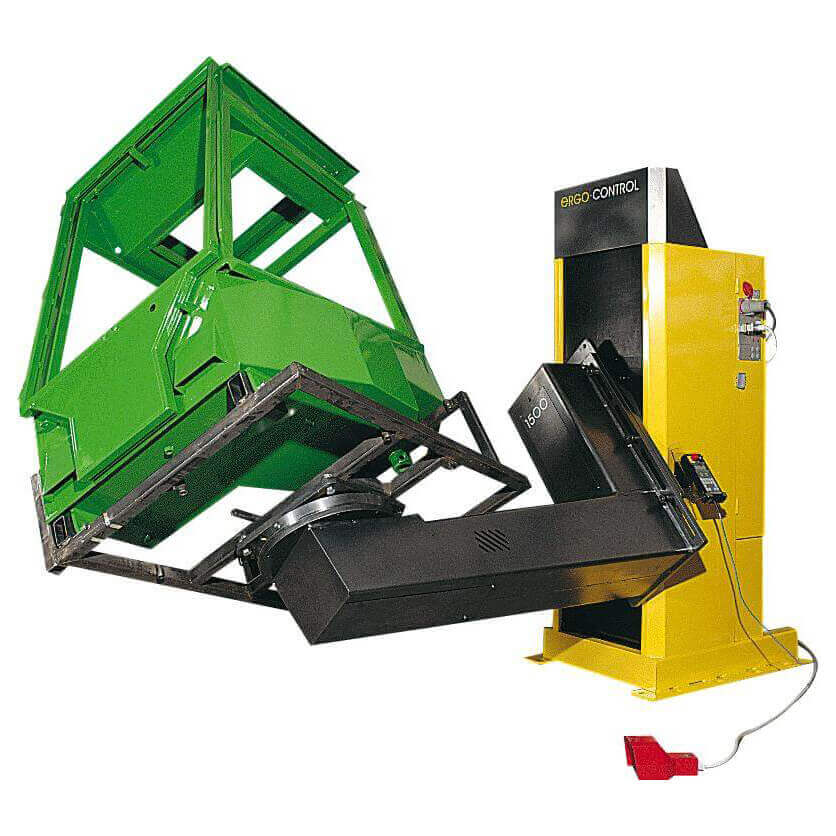
The technology at the heart of this transformation is the multi-axis ergonomic work positioner. Unlike a simple lift or rotator, a true multi-axis positioner provides comprehensive control over a component’s orientation, offering 360° rotation, tilt, and height adjustment. This capability allows a massive, complex assembly to be moved with the same fluidity as a small part in a bench vise.
Consider these real-world scenarios:
- Welding a Complex Fuselage Seam: A technician needs to perform a continuous, high-quality weld along a curved seam on a fuselage section weighing several tons. With a multi-axis positioner like the Ergo Control®, they can stand in one spot while the fuselage is rotated and tilted via a remote control, keeping the weld seam perfectly positioned at waist height throughout the entire process.
- Assembling Components Inside a Wing Structure: A team needs to install hydraulic lines and electrical systems inside a large wing assembly. Instead of using ladders and scaffolding, the entire wing can be tilted and lifted, allowing technicians to perform the work from the safety of the factory floor.
These advanced systems empower a single operator to effortlessly and precisely manipulate even the heaviest components, transforming a hazardous, multi-person job into a safe and efficient one-person task.
Beyond Safety: The Compounding ROI of Ergonomic Positioning
While the safety benefits are clear, the business case for ergonomic positioning is even more compelling. For Operations Managers, the return on investment is measured in productivity, quality, and efficiency. According to industry data, the direct costs of a single MSD can be staggering, but the indirect costs of lost productivity are often far higher.
Investing in a robust manufacturing ergonomics program delivers compounding returns:
- Productivity: Repositioning time can be slashed from hours to mere minutes. The time once wasted coordinating crane lifts and manual adjustments is converted directly into value-added production time.
- Quality: By guaranteeing the optimal work angle for every task, positioners enable higher-quality welds, more accurate riveting, and more consistent assembly. This reduces defects, minimizes rework, and improves final product integrity.
- Labor Optimization: A task that previously required three or four technicians can now be executed by one. This frees up skilled labor to be deployed on other critical tasks, effectively multiplying the capacity of your existing team.
- Reduced Footprint: A single work positioner often requires less floor space than the sprawling manual setups, A-frame gantries, and staging areas needed for traditional methods, optimizing your facility layout.
How to Select the Right Positioning Solution for Your Application
Choosing the right equipment is critical to success. The ideal solution depends on the specific challenges of your application, from the weight of your components to the complexity of the tasks involved.
Here’s how to approach the selection process:
- Assess Load Capacity: Determine the weight range of your assemblies. Solutions are available for a wide spectrum of needs, from lighter-duty models handling 300 lbs to heavy-duty systems capable of positioning over 17,000 lbs.
- Match the Control Type to the Task:
- Manual: For lighter loads and less frequent adjustments, a manual positioner like the Ergo Master® offers a cost-effective solution.
- Motorized: For heavier parts requiring frequent repositioning, a powered system like the Ergo Chief® provides push-button control to reduce operator fatigue.
- Programmable: For complex, repeatable processes, a fully programmable positioner like the Ergo Control® offers the ultimate in precision and automation.
- Consider Key Factors: Evaluate the required range of motion, the type of control interface that best suits your team, and the mounting options needed to secure your specific workpiece.
For truly unique challenges, partnering with an engineering team to develop a custom solution is often the most effective path forward.
Conclusion: Build a Safer, More Productive Facility Today
The core lesson from aerospace leaders is clear: solving ergonomic challenges for large and complex assemblies is not an expense, it is a direct driver of safety, quality, and profitability. By treating positioning as a critical part of the production process, these companies have unlocked new levels of efficiency and protected their most valuable employees from career-ending injuries.
This advanced technology is not reserved for Fortune 500 giants. The same principles and equipment that position aircraft fuselages can be scaled to solve challenges in any heavy manufacturing environment. By bringing the work to the worker, you can build a safer, more competitive, and more productive facility today. Do you have a unique positioning challenge? Contact our engineers for a custom solution.