
Telescopic Lift Columns: How the Ergo I Works

The modern industrial workplace is continuously evolving, striving for innovation, efficiency, and of course, safety. One modern solution that is truly making a difference is the Ergo I Telescopic Lift System. Let us explore how this product is transforming industrial manufacturing workspaces.
Underlying Challenges in Industrial Workplaces
Before understanding the solution, we need to acknowledge the problems. Traditional lifting methods in industrial settings often lead to hazards and inefficiencies that result in significant strain or injury. Regular lifting, carrying, and adjusting heavy items can cause physical fatigue, leading to reduced productivity and potentially severe, long-term health problems for workers.
Introducing the Ergo I Telescopic Lift System
The Ergo I is a state-of-the-art telescopic lift system designed to smoothly, precisely, and quietly adjust work height to a comfortable work position. In doing so it will reduce workplace strain, fatigue, and work-related injuries. The Ergo-I lift is versatile with a wide range of lift capacities and lift strokes. The Ergo I can be a superstar on your shop floor.
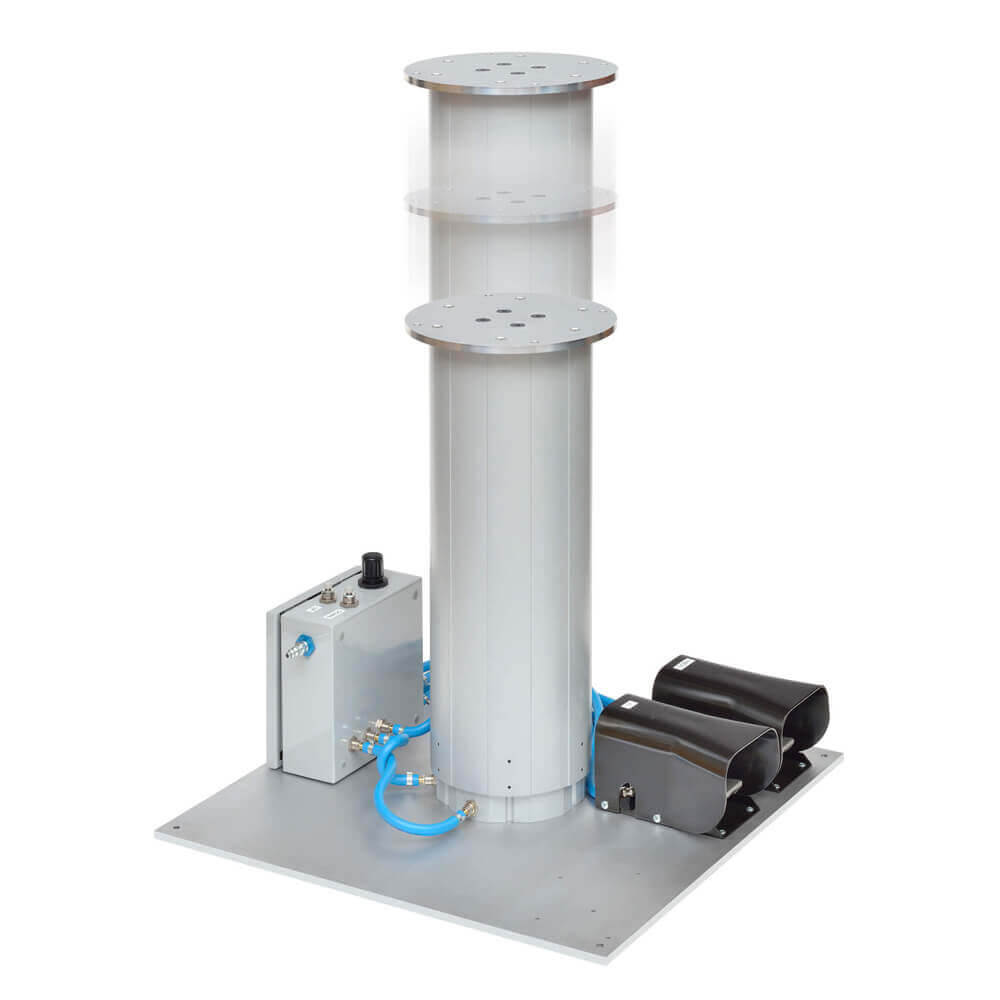 Let’s look at what makes the Ergo I lift column stand out;
- Standard lifting capacities of 400-, 800-, and 1,200-pound per column.
- 1200 pound version can be synchronized with up to four columns working in tandem.
- Standard stroke lengths of 12 inches and 16 inches
- Pneumatic or electrically powered
- Hand pendant, foot pedal, or PLC input operation.
- 110 VAC or 220 VAC or 12 VDC or 24 VDC.
The Ergo I standard lift columns provide flexibility in use and application with only a small 10” circular footprint. Each unit come equipped with built-in thermal overload protection and structural rigidity for use in any shop floor lift application.
The Ergo I Telescopic Lift System, renowned for its reliability and durability, is a state-of-the-art solution to these challenges. This system is designed to adjust work height with precision while reducing workplace strain and consequently, work-related injuries.
How the Ergo I Improves Efficiency
The Ergo I comes equipped with standard lifting capacities of 400, 800, and 1,200 pounds per column. The 1,200-pound version can even be synchronized with up to four columns working simultaneously, ensuring a smooth and efficient lifting process.
Compact and Flexibly Powered
With a small 10” circular footprint, the Ergo I manages to be incredibly compact while maintaining its high performance. It can be powered both pneumatically or electrically, with options for 110 VAC or 220 VAC or 12 VDC or 24 VDC. It can operate by using a hand pendant, foot pedal, or a PLC input.
Improving Safety Standards with a Telescopic Lift System
The system offers standard stroke lengths of 12 and 16 inches, enabling workers to lift heavy loads to a comfortable and safe working height. With built-in thermal overload protection, the Ergo I ensures safe operation, preventing machinery failures that can lead to workplace injuries.
Testimonials and Proven Track Record
Ergotronix has an impressive record of customer satisfaction. One customer noted, “We have had good luck with the Ergotronix products and they fill our application nicely. Compact systems without any maintenance.” This reinforces Ergo I’s reputation as a dependable, low-maintenance solution for lifting requirements.
We have had good luck with the Ergotronix products and they fill our application nicely. Compact systems without any maintenance.
Ergo I: A Game-Changer for Industrial Workspaces
The Ergo I lift column can act as a stand-alone unit or as part of a larger automated lifting network. It can be configured with multiple stroke lengths, push strengths, and power sources. This flexibility enables the Ergo I to handle almost any lifting need in a manufacturing, production, or any other height adjustment setting. If your shop floor needs a telescopic lift, look no further than the Ergo I.