Platform Lift or Work Positioner: The Right Machine for Maximum Safety

Key Takeaways
- A simple platform lift only moves vertically, while a work positioner offers multi-axis control (lift, tilt, rotation) for safety and efficiency.
- Always account for the workpiece’s dimensions, center of gravity, and the weight of tooling—not just its payload weight—to avoid dangerous under-specifying.
- Choose manual positioners for infrequent, lighter tasks and motorized systems for applications requiring frequent adjustment, heavy loads, or high precision.
- The right interface (hand pendant, foot pedal, or programmable controls) is critical for operator adoption, speed, and the consistency of repeatable tasks.
- The right ergonomic equipment prevents costly injuries, reduces downtime, and improves product quality, often paying for itself in under two years.
Choosing the right equipment to lift and position heavy or unwieldy components is one of the most critical decisions an operations manager can make. You may be searching for a “platform lift,” but in a high-stakes industrial environment, simply moving a workpiece vertically is rarely enough. True efficiency, operator safety, and product quality are achieved not just by lifting, but by precisely “positioning” that workpiece in multiple axes.
This guide moves beyond generic spec sheets to provide a clear engineering framework for selecting an industrial work positioner. We will explore how to accurately define your load requirements, match equipment capabilities to your specific application, and calculate the undeniable return on investment that comes from choosing the right ergonomic solution. Making the correct decision prevents injuries, eliminates production bottlenecks, and directly protects your bottom line.
Your Forklift or Scissor Lift Isn’t a Work Positioner
In any facility, there are tools for lifting and tools for working. A forklift or basic scissor lift is designed for one primary task: moving a load from one elevation to another. This is simple, single-axis movement. An ergonomic work positioner, however, is an engineered solution designed to securely grip a workpiece and move it through multiple axes—including height, tilt, and 360° rotation—to place it in the optimal position for the task at hand.
Using the wrong equipment for the job introduces significant risks. Attempting to manually tilt a heavy component off a scissor lift can lead to catastrophic accidents and severe operator injury. It also forces employees into awkward, non-ergonomic postures, which slows down work, compromises quality, and increases the chance of product damage. A true work positioner is a productivity tool built for active engagement, ensuring the work is always brought perfectly to the worker, not the other way around.
The Foundation: Accurately Calculating Your Load Requirements
The most common mistake in selecting a work positioner is misunderstanding the true load. The number on the spec sheet is only the beginning of the story. You must move beyond simple payload and account for the principles of load moment and eccentric loads.
Imagine holding a 20-pound weight close to your chest—it’s manageable. Now, extend your arms fully. That same 20 pounds feels exponentially heavier because the center of gravity has shifted. The same principle applies to a work positioner. A 500-pound workpiece centered perfectly on the lift is one thing; a 500-pound workpiece that is long, irregularly shaped, or must be held 24 inches from the lifting column exerts a much greater force.
Furthermore, you must factor in the weight of any tooling or fixtures used to hold the workpiece. These additions can significantly increase the total load and shift the center of gravity. Under-specifying a positioner based on workpiece weight alone is a direct path to premature equipment failure and a serious safety hazard. Over-specifying, while safer, means you’ve invested in capacity you’ll never use.
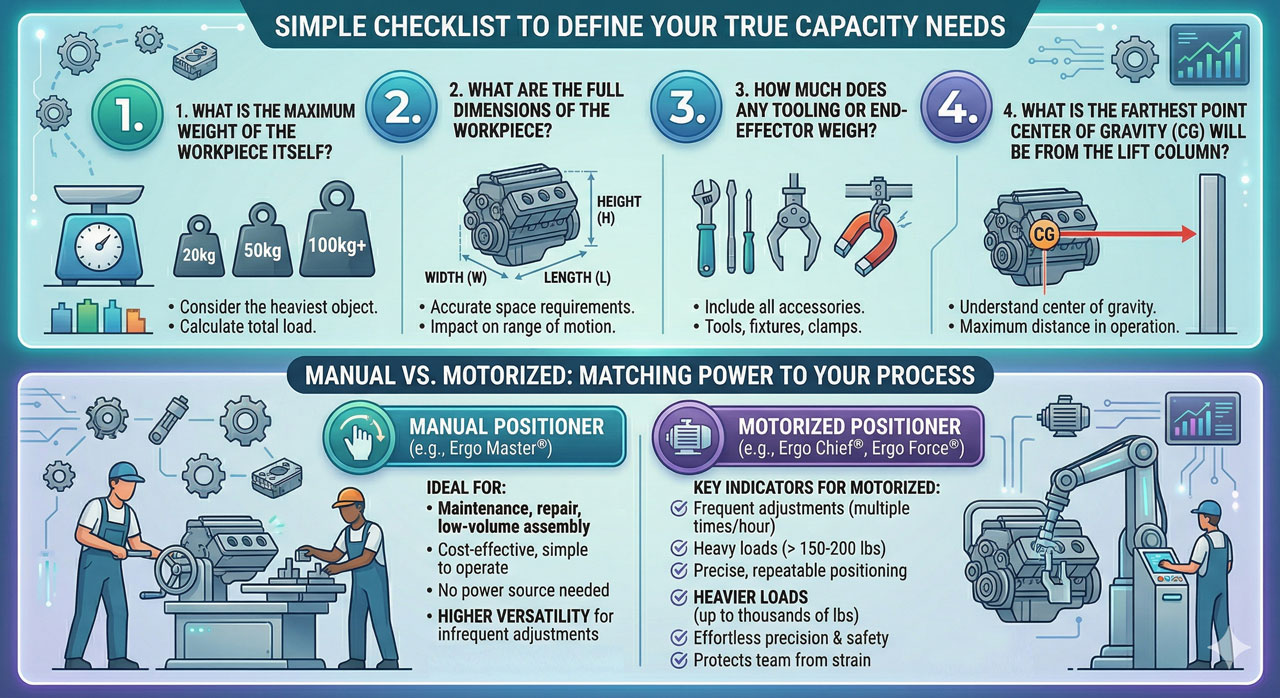
A simple checklist to define your true capacity needs:
- What is the maximum weight of the workpiece itself?
- What are the full dimensions (length, width, height) of the workpiece?
- How much does any tooling or end-effector weigh?
- What is the farthest point the workpiece’s center of gravity will be from the lift column during the operation?
Manual vs. Motorized: Matching Power to Your Process
The choice between a manual and a motorized system depends entirely on your application’s frequency, load, and precision requirements.
A manual positioner, like the Ergotronix Ergo Master®, is an excellent choice for maintenance, repair, or low-volume assembly tasks where loads are lighter and adjustments are infrequent. These systems are cost-effective, simple to operate, and require no power source, making them highly versatile.
However, key indicators will tell you when a motorized solution is necessary. If operators are adjusting the positioner multiple times per hour, if the load exceeds 150-200 lbs, or if the application requires precise, repeatable positioning, a motorized system is essential. Motorized options like the Ergo Chief® are designed for higher-frequency tasks and heavier loads, while robust systems like the Ergo Force® can handle thousands of pounds with effortless precision, protecting your team from strain and fatigue.
Defining Your Movement: From Simple Lifts to 6-Axis Positioning
Once you’ve defined your load, map your workflow to determine the necessary axes of movement. The three primary axes are:
- Lift (Height): The vertical travel required to move the workpiece from its starting point to the ideal ergonomic working height for the operator.
- Tilt: Angling the workpiece to provide better access for tasks like welding, deburring, or component installation.
- Rotation: Spinning the workpiece around a central axis.
When is 360° continuous rotation critical? For complex assembly or welding applications, the ability to rotate a workpiece without interruption is paramount. It allows the operator to remain in a fixed, safe position while the part moves, ensuring better weld quality and reducing fatigue. For the most demanding tasks, such as completely inverting a heavy transmission or engine block for service, an advanced positioner like the Ergo Force® provides the necessary power and stability.
Control is Everything: Choosing the Right Interface for Your Team
The most advanced work positioner is only effective if it’s easy for your team to operate. The control interface is a critical component of usability and safety. Hand pendants offer portability and fine control, allowing the operator to move around the workpiece while making adjustments. Foot pedals, conversely, leave the operator’s hands free to steady the part or manage tools, which is ideal for certain assembly or inspection tasks.
For high-volume, repeatable processes, the power of programmable controls cannot be overstated. Systems like our Ergo Control® series allow you to “teach” the positioner a specific sequence of movements. With the push of a single button, the machine can execute a complex routine flawlessly every time. This not only boosts throughput but also guarantees a level of consistency that is impossible to achieve manually, reducing training time for new operators and minimizing the risk of error.
The Business Case: Calculating the ROI of Proper Selection
Investing in a high-quality ergonomic work positioner is not an expense; it is a strategic investment in uptime, safety, and productivity. Musculoskeletal disorders (MSDs) are one of the leading causes of lost workdays in the manufacturing sector. According to the Bureau of Labor Statistics, MSD cases account for approximately 30% of all days-away-from-work cases in the U.S. private sector, representing a massive cost in workers’ compensation, lost productivity, and employee morale.
The ROI of an ergonomic work positioner can be measured in several ways:
- Injury Reduction: Calculate the direct and indirect costs of a single back or shoulder injury. The right equipment often pays for itself by preventing just one serious incident.
- Productivity Gains: Measure the time saved when an operator can position a heavy part in seconds with a button push versus minutes with a crane and chains.
- Quality Improvement: Optimal positioning leads to better craftsmanship, fewer errors, and less scrap.
A proper work positioner can often deliver a full return on investment in less than 18 months, making it one of the most compelling capital projects you can undertake.
Finding Your Solution: When to Go Custom
Sometimes, a standard product doesn’t quite fit your unique workflow, workpiece, or facility constraints. Signs that you may need a custom solution include an unusually shaped part, extreme space limitations, or the need to integrate the positioner with other automated equipment.
This is where working with a true engineering partner becomes critical. The process involves a deep dive into your operational goals, resulting in a solution designed and built specifically for your application. From unique end-effector tooling to specialized control systems, a custom work positioner ensures you are not forcing a standard piece of equipment to do a job it wasn’t designed for.
Choosing the right industrial work positioner is a decision that pays dividends long after the initial purchase. By moving beyond a simple lift and focusing on the complete ergonomic and positioning needs of your application, you create a safer, more productive, and more profitable operation.
Have a complex application? Schedule a free consultation with an Ergotronix engineer today to discuss your positioning needs.