Post-Amazon Settlement: OSHA’s New Ergonomic Enforcement Baseline Explained

Key Takeaways
- The OSHA-Amazon settlement established a new, more aggressive enforcement precedent for ergonomic hazards using the General Duty Clause.
- OSHA is primarily targeting three key ergonomic risks: awkward postures (bending, reaching), forceful exertions (lifting, pushing), and repetitive motions.
- A strategic approach involves a three-step framework: Assess risks, Implement engineering controls like work positioners, and Measure the impact on both safety and productivity.
- Investing in advanced ergonomic equipment provides a strong ROI by reducing the high direct and indirect costs of musculoskeletal disorders (MSDs) and boosting operational efficiency.
- Proactive ergonomic design is no longer just a best practice; it’s a competitive advantage and a fundamental component of a modern, resilient manufacturing operation.
The recent, highly publicized settlement between OSHA and Amazon has drawn a new line in the sand, transforming ergonomic safety from a best practice into a top-tier enforcement priority. This isn’t just about Amazon; it’s a clear signal to all industrial employers that “the way we’ve always done it” is no longer a defensible strategy.
If you’re wondering what this new baseline means for your operations, you’re asking the right question. This isn’t about scrambling for basic compliance. It’s about seizing a critical opportunity to move beyond the minimums and build a true competitive advantage. This article will break down the practical implications of OSHA’s new stance, decode the specific hazards now under the microscope, and provide a clear framework for implementing ergonomic solutions that protect your team and your bottom line.
The Amazon Settlement: Why OSHA’s New Focus on Ergonomics is a Wake-Up Call
In May 2024, OSHA and Amazon reached a landmark settlement regarding ergonomic hazards at several of the retail giant’s warehouse facilities. While the fines were significant, the real story is *how* OSHA approached the case. Lacking a specific ergonomic standard, the agency leveraged its General Duty Clause, which requires employers to provide a workplace “free from recognized hazards that are causing or are likely to cause death or serious physical harm.”
By successfully applying this clause to ergonomics on such a large scale, OSHA has established a powerful new enforcement precedent. The key takeaway for every production supervisor and plant manager is this: OSHA is no longer just reacting to injuries. It is now proactively targeting the *root causes* of musculoskeletal disorders (MSDs) the awkward postures, forceful exertions, and repetitive motions that quietly drain productivity and lead to costly injuries. This settlement is the first shot across the bow, signaling a nationwide focus on ergonomic design that will undoubtedly extend from warehousing to the manufacturing floor.
Decoding OSHA’s Hit List: The Top 3 Ergonomic Hazards in Their Crosshairs
The Amazon citations provide a clear roadmap to OSHA’s priorities. Understanding these target hazards is the first step to evaluating your own facility’s risk profile.
Hazard 1: Awkward Postures (Bending, Reaching, Twisting)
When workers must consistently bend at the waist, reach far above shoulder height, or twist their bodies to access or assemble parts, their muscles and spinal discs are put under immense strain. These non-neutral postures are a leading cause of chronic back, neck, and shoulder injuries. A workstation that forces an employee to hold a heavy tool at an unnatural angle is a textbook example of a recognized hazard under this new enforcement lens.
Hazard 2: Forceful Exertions (Lifting, Pushing, Pulling Heavy Loads)
Manually lifting heavy components, pushing loaded carts up inclines, or pulling pallets creates high-stress events for the musculoskeletal system. According to the Bureau of Labor Statistics, overexertion and bodily reaction are the most common causes of work-related injuries requiring days away from work [EXTERNAL LINK: Authoritative Industry Source Citation]. The risk multiplies when these exertions are combined with awkward postures, such as lifting a heavy box from the floor while twisting.
Hazard 3: Repetitive Motions
Performing the same motion over and over, especially without sufficient recovery time, leads to cumulative trauma. This is particularly prevalent in assembly line work, packaging, or tasks like welding. While the individual motion may seem low-risk, the high frequency can lead to debilitating conditions like carpal tunnel syndrome and tendonitis, directly impacting quality and throughput.
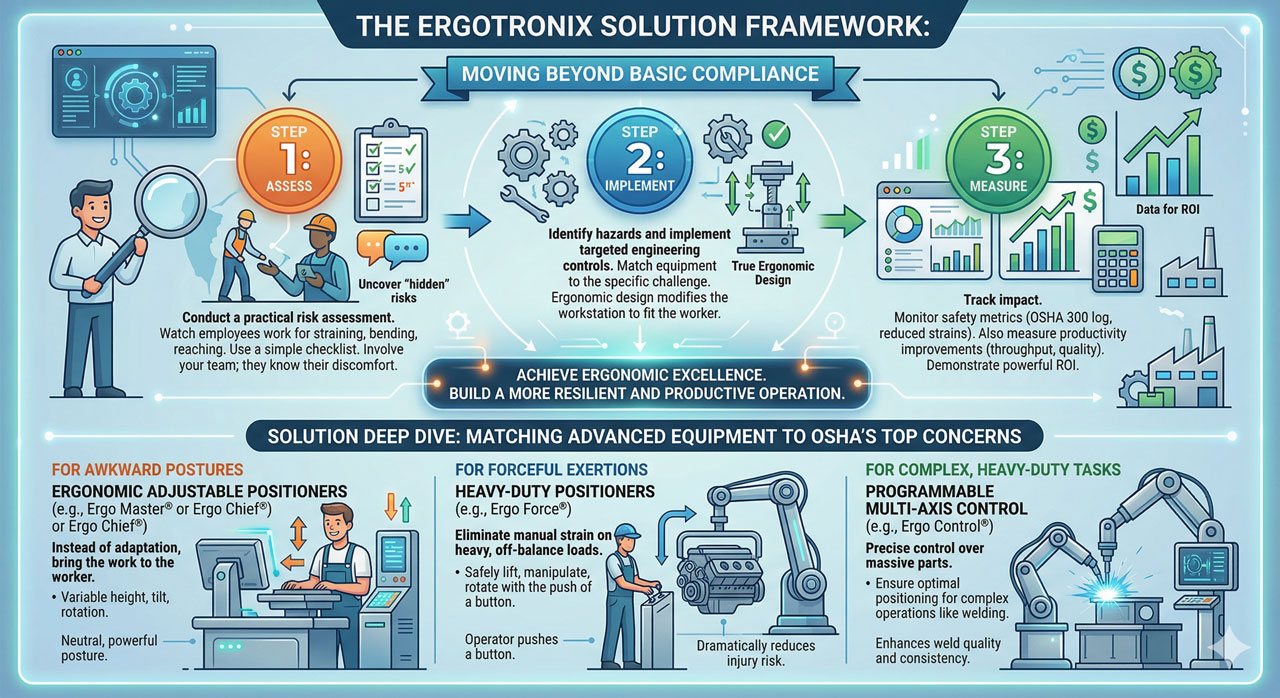
The Ergotronix Solution Framework: Moving Beyond Basic Compliance
Reacting to this new reality with a simple compliance checklist is a missed opportunity. The goal isn’t just to avoid a fine; it’s to build a more resilient and productive operation. At Ergotronix, we guide our partners through a strategic framework designed to achieve ergonomic excellence.
Step 1: Assess
Begin by conducting a practical risk assessment. Watch your employees work. Where are they bending, reaching, or straining? Use a simple checklist to score tasks based on posture, force, and repetition. Involve your team directly; they are the experts on their own discomfort. This process uncovers the “hidden” risks that often go unnoticed until an injury occurs.
Step 2: Implement
Once you’ve identified the hazards, the next step is to implement targeted engineering controls. This is where matching the right equipment to the specific hazard is critical. Administrative controls like job rotation are helpful, but they don’t eliminate the root cause. True ergonomic design modifies the workstation to fit the worker, not the other way around.
Step 3: Measure
Track the impact of your interventions. Monitor key safety metrics like your OSHA 300 log and a reduction in first aid visits for strains. But don’t stop there. Measure productivity improvements. How has throughput at a specific workstation changed? Has the quality of work improved with better positioning? This data is crucial for demonstrating the powerful ROI of your ergonomic investments.
Solution Deep Dive: Matching Advanced Equipment to OSHA’s Top Concerns
Generic solutions yield generic results. To effectively address the hazards on OSHA’s hit list, you need equipment designed for the specific challenge.
- For Awkward Postures: Instead of forcing a worker to adapt to a fixed-height table, an adjustable work positioner like the Ergo Master® or Ergo Chief® brings the work to the worker. With variable height, tilt, and rotation capabilities, these systems allow employees to maintain a neutral, powerful posture whether they are working on a small component or a large assembly.
- For Forceful Exertions: Manually flipping a 300lb engine block is a high-risk task that is now a clear compliance liability. The Ergo Force® work positioner allows a single operator to safely lift, manipulate, and rotate heavy, off-balance loads with the push of a button. This eliminates the manual strain and dramatically reduces the risk of a career-ending injury.
- For Complex, Heavy-Duty Tasks: In sophisticated applications like aerospace or automotive welding, operators need precise control over massive, unwieldy parts. The Ergo Control® provides programmable, multi-axis positioning, ensuring that the weld seam is always in the optimal position. This not only eliminates awkward postures and strain but also directly enhances weld quality and consistency.
Building the Business Case: How Ergonomics Pays for Itself
Investing in advanced ergonomic equipment isn’t a cost center; it’s a strategic investment in operational excellence. The data is clear: musculoskeletal disorders are one of the single largest drivers of workers’ compensation costs. According to OSHA, indirect costs such as lost productivity, training replacement workers, and administrative time can be up to four times the direct cost of the claim itself.
Consider the ROI. A single Ergo Chief® positioner that prevents one serious back injury has likely already paid for itself. But the benefits go further. When employees aren’t fatigued or in pain, they are more focused, more efficient, and produce higher-quality work. Reduced downtime from injuries and increased throughput from optimized workstations translate directly to a stronger bottom line.
Your Next Steps: Implementing a Proactive Ergonomics Strategy
The OSHA-Amazon settlement is your cue to act. Don’t wait for an inspector to show up at your door or for a preventable injury to sideline one of your best employees. A proactive ergonomic strategy is the new standard for well-managed industrial operations.
Start by walking the floor with the hazards we’ve discussed in mind. Talk to your team and identify the most physically demanding tasks in your facility. The path forward involves a commitment to continuous improvement, driven by employee feedback and supported by the right equipment. Contact Ergotronix to start building a safer, more productive, and more profitable operation that is ready for this new era of enforcement.