Why Multi-Directional Conveyor Rollers Eliminate Material Handling Bottlenecks

Key Takeaways
- Traditional conveyors create bottlenecks, safety risks, and inflexibility. Multi-directional rollers solve these issues by enabling 360-degree movement on the spot.
- By eliminating the stops and pauses required by turntables and diverters, omni-directional technology significantly reduces cycle times and increases OEE.
- Mechanizing the rotation and positioning of heavy items reduces the risk of musculoskeletal injuries, leading to a safer and more productive workforce.
- This technology allows for more compact line designs, freeing up valuable floor space by eliminating the need for wide curves and bulky transfer mechanisms.
- A successful implementation requires careful planning around load, speed, and controls. Partnering with an expert ensures a seamless transition and maximized ROI.
Production lines are like rivers. When the flow is smooth, everything gets where it needs to go efficiently. But a single snag, a sharp turn, a manual transfer, or an awkward rotation can create a bottleneck that backs up the entire system. These chokepoints don’t just slow down production; they inflate labor costs, compromise worker safety, and make it nearly impossible to adapt to changing demands.
For operations managers and production supervisors, the constant pressure to increase throughput while protecting your team is a daily challenge. You’ve likely seen firsthand how a rigid, linear conveyor system forces inefficient workarounds. The solution isn’t about working harder; it’s about moving smarter. This article explores how a fundamental shift in movement from a straight line to 360-degree mobility can solve your most persistent material handling challenges. We’ll break down how multi-directional conveyor rollers work, where they deliver the most significant impact, and how to integrate them to create a safer, more flexible, and more productive workflow.
What Are Multi-Directional Conveyor Rollers?
Imagine a conveyor surface that can move a product in any direction forward, backward, sideways, diagonally, or rotate it 360° on the spot without ever lifting it. That is the power of multi-directional conveyor rollers.
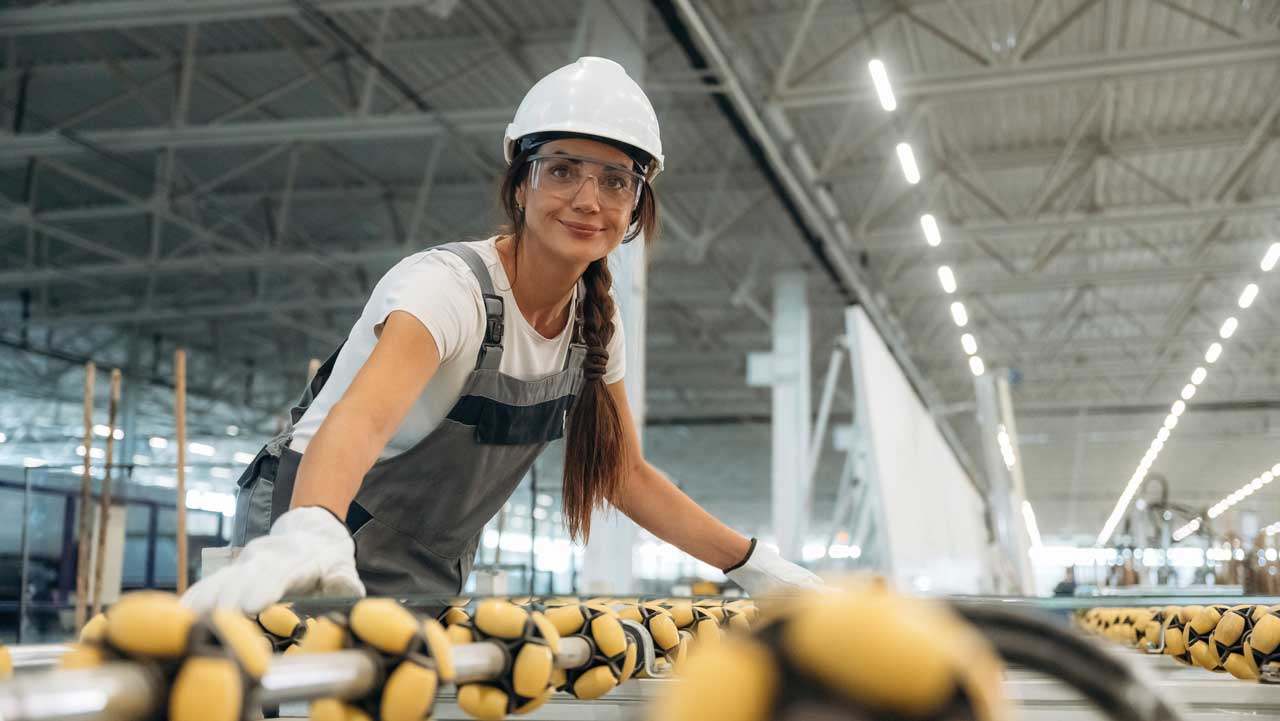
Unlike traditional rollers, which only spin on a single axis, these advanced components utilize a series of smaller, barrel-shaped wheels (often called “omni wheels”) integrated along the main roller’s surface. These smaller wheels are oriented at an angle, typically 45 or 90 degrees, to the primary roller’s direction. By controlling the rotation of adjacent rollers, you can engage different sets of these angled wheels to create precise, fluid movement in any direction on a horizontal plane.
The key difference between this technology and older solutions is its seamlessness. A traditional turntable, for instance, must stop the product, lift or rotate it, and then lower it back onto the line—a multi-step process that creates a significant pause in workflow. Pop-up transfer units are similarly disruptive and require complex mechanics that take up valuable space. Multi-directional rollers, however, perform these maneuvers on the fly, creating a smooth, uninterrupted flow that is essential for high-throughput operations.
The Hidden Costs of Your Linear Conveyor System
The price of a conveyor system isn’t on the initial invoice; it’s measured in the day-to-day operational costs of its limitations. Traditional, single-direction rollers are excellent for moving items from Point A to Point B in a straight line. But modern manufacturing is rarely that simple.
The moment a product needs to be rotated, reoriented, or diverted, the hidden costs of a linear system begin to add up. These costs manifest as production bottlenecks, where items queue up waiting for a manual lift, a slow turntable, or a cumbersome transfer cart. Every second spent waiting is a direct hit to your Overall Equipment Effectiveness (OEE) and a delay for your customer.
Furthermore, these workarounds often introduce significant safety risks. When employees have to manually push, pull, or lift heavy or awkward items to bridge gaps in automation, the potential for injury rises dramatically. In fact, the manufacturing sector remains a high-risk environment, accounting for a significant portion of all private industry nonfatal injuries and illnesses. Many of these are musculoskeletal disorders (MSDs) stemming from overexertion and repetitive, awkward movements, the exact motions required to compensate for an inflexible conveyor.
Finally, in a high-mix, custom-order world, linear systems are inherently inflexible. Rerouting product flow to accommodate a new assembly process or a different product size can require a costly and time-consuming reconfiguration of your entire line. Your conveyor system should enable agility, not hinder it.
Core Benefit #1: Eliminate Bottlenecks and Boost Throughput
The most immediate impact of multi-directional conveyor rollers like the Ergo Roll is the dissolution of bottlenecks. Consider a typical packaging line where boxes need to be sorted and sent to different palletizing stations. A traditional system would require a series of pushers, diverters, and angled spurs—a complex and maintenance-heavy setup prone to jams.
With an omni-directional conveyor table, boxes can be routed, sorted, and aligned with precision and speed. A box arriving from the left can be instantly redirected to a station on the right without stopping. This ability to merge, divert, and sort products in a compact space drastically reduces cycle time. By eliminating the pauses and mechanical delays inherent in older systems, you can achieve a significant increase in your OEE and overall plant throughput.
Core Benefit #2: Enhance Workplace Safety and Ergonomics
Reducing risky manual handling is one of the most compelling reasons to upgrade your material handling technology. Every time a worker has to manually reorient a heavy sub-assembly or slide a large component into position, you risk a costly injury. According to the U.S. Bureau of Labor Statistics, overexertion and bodily reaction are leading causes of workplace injuries that result in days away from work.
Multi-directional rollers eliminate the need for these hazardous manual tasks. By mechanizing the rotation and positioning of products, you remove the physical strain from your employees. This technology pairs exceptionally well with ergonomic work positioners, allowing an operator to rotate a heavy chassis or engine block with push-button ease to access the ideal working angle. This not only creates a safer work environment but also reduces fatigue, improves focus, and leads to higher quality work. The financial impact is clear: fewer injuries mean less downtime, lower workers’ compensation claims, and a more positive and productive workforce.
Core Benefit #3: Reclaim Valuable Floor Space
In any manufacturing facility, floor space is a finite and valuable asset. Bulky turntables, wide-radius curved conveyors, and the extra clearance needed for transfer carts consume a massive amount of real estate. This is space that could be used for value-added activities like additional assembly stations or inventory storage.
Multi-directional conveyor systems enable far more compact and efficient production layouts. Since 90-degree transfers and rotations can happen within the conveyor’s own footprint, you can eliminate the sweeping curves and mechanical appendages of a linear system.
- Before: A line requiring a 90-degree turn might use a wide, curved conveyor section that creates a large, unusable area in the center of the turn.
- After: A multi-directional transfer table can execute the same 90-degree turn in a compact square, allowing you to run other lines or place workstations much closer together.
This space optimization allows for more logical and streamlined facility designs, ultimately increasing your plant’s overall capacity without a costly expansion.
Applications in Your Industry
The benefits of multi-directional movement are not theoretical; they are being applied today to solve real-world challenges in demanding industries.
- Automotive: On vehicle assembly lines, these systems are used to maneuver chassis and sub-assemblies between stations. The ability to move a car body sideways into a workstation allows for tighter line spacing and easier access for robotic welders and human operators.
- Aerospace: When dealing with large, high-value components like fuselage sections or wing assemblies, precision and safety are paramount. Omni-directional platforms allow for the delicate positioning of these items without the need for overhead cranes, reducing the risk of damage and improving worker safety.
- General Manufacturing: For businesses that handle a wide variety of product sizes and custom orders, the flexibility of multi-directional rollers is a game-changer. A line can be instantly reprogrammed to divert, rotate, or re-center different products without any mechanical changeover, making it ideal for agile and lean manufacturing environments.
Integrating Multi-Directional Rollers Into Your Workflow
Adopting this technology is more than just swapping out a piece of equipment; it’s an opportunity to rethink your entire workflow. When planning an integration, key considerations include the load capacity of the rollers, the required speed and acceleration, and the sophistication of the control system needed to achieve precise movements.
A successful transition starts with a thorough analysis of your current process to identify the most critical bottlenecks. It’s important to work with a partner who understands not just the technology itself, but how to apply it to solve your specific operational challenges. An expert can help you design a custom solution that integrates seamlessly with your existing conveyors, ergonomic equipment, and control architecture. This is the Ergotronix advantage: we provide not just components, but a complete, consultative approach to optimizing your material flow.
Ready to move beyond the limits of the straight line? By embracing 360-degree movement, you can unlock new levels of productivity, create a safer workplace, and build a more agile and resilient production process.
To see how your facility could benefit from a more flexible workflow, request a free workflow assessment with one of our material handling experts.